
Functional elucidation of nitrogen-doped carbon catalysts
and their application to energy materials
Principal Investigator:NAKAMURA Junji Researcher Number:40227905
Project Number:23H05459 Project Period (FY):2023~2027
Keywords:Nitrogen-doped carbon, catalyst, fuel cell, carbon neutral, CO2
Purpose and Background of the Research
● Outline of the Research (Fig. 1)
Nitrogen-doped carbon materials are expected as new energy materials. In particular, electrocatalysts are key materials in a carbon-neutral society and play a major role in fuel cells and the conversion of CO₂, a greenhouse gas. In this research, we will clarify the function of doped nitrogen and develop highly active electrocatalysts.

Figure 1. Outline of the research
● Purpose and Background of the Research
Carbon neutrality is an urgent issue in the face of the crisis of global warming, and construction of a hydrogen society using hydrogen as an energy medium is expected. In the hydrogen society, fuel cells are used as power generators, but in order to spread them on a full scale, it is necessary to replace the expensive platinum used in catalysts with inexpensive materials, and attention is focused on nitrogen-doped carbon catalysts. However, its catalytic activity has not reached the stage of practical use. The purpose of this research is to design a carbon catalyst that can be used for commercial fuel cells by improving the activity based on the knowledge of the reaction mechanism. In particular, we conceived that π* electrons and O₂ adsorption are the most important factors that determine activity.
● Originality
We found that pyridinic nitrogen (pyri-N) forms catalytically active sites in doped nitrogen (SCIENCE 2016). Furthermore, detailed studies of the role of this pyridinic nitrogen indicate that an electrochemical elementary process (reduction of pyridinium pyri-NH+) and a thermal reaction (oxygen adsorption) is coupled as follows (Angew Chem. 2021).

This reaction is the key to the development of fuel cell electrode catalysts. Based on the knowledge, we fabricated a graphene catalyst with world-class activity that posses a hydrophobic cage structure suppressing the hydration of pyri-NH+ (Fig. 2, Angew. Chem. 2022). In this research, aiming at even higher activity, we will elucidate the mechanism (particularly the contribution of spin electrons) in detail and prepare a carbon catalyst with a highly controlled structure.

Figure 2. caged graphene catalyst
Expected Research Achievements
● Mechanistic study 1: Detection of reaction intermediates during the reaction with broadband Coherent Anti-Stokes Raman Scattering Spectroscopy (CARS) to elucidate the reaction mechanism.
● Mechanistic study 2: Detection of spin formed in nitrogen-doped carbons by spin-polarized scanning tunneling microscope (STM) that can observe atoms and electrons to prove our original hypothesis.
●Catalyst development 1: Design of carbon particles that have hollow structures controlling the movement of molecules, protons, and electrons. Fullerene and graphene will be used as starting materials. The point is to control the hydrophilicity (water gets wet) and hydrophobicity (water repels) inside and outside.
●Catalyst development 2: Design of non-platinum fuel cell catalysts and CO₂ conversion catalysts based on the mechanistic studies. The targets are catalysts for fuel cells (for cathodes) and catalysts for the electrochemical conversion of CO₂ into useful compounds

Figure 3. CARS microscope
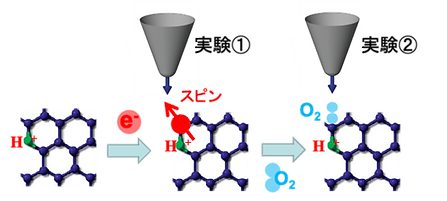
Figure 4. Detection of spin near N atom

Figure 5. Preparation of hollow structure carbon catalyst

Figure 6. Introduction of active sites and functional particles into the hollow structure. This shows a catalyst in which silica particles coated with a proton-supplying polymer are introduced into a hollow structure.